Why the 5-Star Hotel Guest Review System Is Broken (And What Independent Hospitality Deserves Instead)

Updated: Jun 11
Table Of Contents
A guest review gives you THREE stars on TripAdvisor, Google, Booking.com, Agoda, or whichever OTA you rely on most.
What does that mean? You have no idea and neither does anyone else.
Three stars sits somewhere between terrible and great and that is genuinely all you know. No context. No definition. No way to understand what three meant to the person who pressed it.
Were they disappointed? Were they pleasantly surprised given low expectations? Were they the kind of person who simply never gives five stars to anything on principle? Did something specific go wrong or was it just a general feeling they couldn’t quite articulate?
You will never know because the system wasn’t built to tell you.
Where the Five Star Hotel Review System Came From

The star rating system has roots going back to hotel classification schemes from the early twentieth century. Michelin introduced star ratings for restaurants in 1926. The concept was simple and practical: a shorthand for quality that anyone could understand at a glance.
It worked well for a world where information was scarce and choices were limited. When you had three restaurants to choose from, knowing one had more stars than the others was useful.
Then the internet happened. Suddenly millions of consumers were rating everything. Hotels. Restaurants. Cafes even delivery drivers and the system that was designed for professional critics rating a handful of establishments was handed to the general public to rate everything they ever experienced.
The five star system scaled. The meaning didn’t.
Why Star Ratings Are Misleading: The Definition Problem Nobody Talks About
Here is the fundamental flaw. Five data points with no agreed definition for any of them.
One guest’s three stars is another guest’s four stars. One guest’s five star review is another guest’s four because they never give perfect scores to anything on principle. One guest gives a three star review because they were genuinely disappointed. Another gives three stars because they felt guilty giving two but couldn’t bring themselves to give four.
Same number. Completely different experiences. Completely different meanings.
The middle ground is the worst. Three stars. For some people that means it was fine. For others it means they were quietly furious but wanted to seem reasonable. For others it is the closest thing to a complaint they knew how to make.
Five data points. No definitions. No context. No consistency.
Now imagine something different entirely.
A guest drags a slider.
They move it to 3 and the word that appears says Disappointing.
They move it to 5 and it says Mediocre.
They move it to 7 and it says Good.
They move it to 10 and it says Magical.
Suddenly the number means the same thing to every single guest who submits it. Because the word told them exactly what they were choosing. They didn’t interpret the number. The number interpreted itself for them.
That is the difference between five stars and a defined ten point scale. Not just more data points. Consistent, defined, universally understood data points.
A 6 out of 10 means the same thing across every guest who submits it. A 3 out of 10 means disappointing to every single person. Not disappointing to some and acceptable to others. Disappointing. Defined. Consistent. Comparable.
I designed the Guest Connection Score feedback form personally and deliberately using a ten point scale with word descriptors at every level precisely because of this. The difference between a 6 and a 7 tells you something specific. The difference between a 3 and a 4 tells you something specific. On a five star scale the difference between a 3 and a 4 could mean almost anything.
The 4.5 Problem: How the Hotel Review Score Threshold Is Destroying Independent Hospitality
Here is something I want every independent hospitality operator to read carefully.
When I search for restaurants, whether in a city I am visiting or on a food delivery app, anything below a 4.5 does not get looked at. Full stop.
I do not consider it. I do not read the guests reviews. I scroll past it. The business has lost my custom before I even know what they offer.
Now I am one person but what if millions of other consumers operate the same way?
The data suggests they do. Research consistently shows that consumers are increasingly filtering by review score before they read a single word of feedback. The score acts as a gatekeeper. Anything below a certain threshold simply does not exist in the consideration set.
On a five star guest review scoring scale that threshold has become 4.5. Not four. Not four point two. Four point five.
Think about what that means for an independent operator. On a scale of one to five, where the maximum is five, you need to be averaging 4.5 or above just to be considered by a significant portion of your potential customers. A score of 4.0, which by any reasonable measure represents a good business delivering a decent experience to the vast majority of its guests, is effectively invisible to a growing number of consumers.
You are being penalised not because you are bad, but because you are not perfect enough on a scale that was never designed to measure perfection.
Here is where the inequality between independent and corporate hospitality becomes stark.
A score of 4.0 for a well known corporate branded hotel, restaurant or cafe barely registers with consumers. Brand trust fills the gap. The name does the heavy lifting. People book with Marriott or eat at a major chain because they know what to expect, regardless of the score.
A score of 4.0 for an independently owned hotel, restaurant, bed and breakfast or cafe makes all the difference in the world when compared to the property down the road with a 4.4.
The independent operator with 4.0 loses. Not because they are worse, but because they are operating on a playing field that was never designed with them in mind.
Why the Hotel Review System Penalises You for Things Beyond Your Control
The five star system has another flaw that operators rarely talk about openly. It has no mechanism for context or proportion.
A single irrational review from a guest who arrived with unrealistic expectations and a bad attitude can drag your score from 4.6 to 4.3 overnight. Months of excellent work, dozens of happy guests, a team delivering consistently, wiped out by one person having a bad day.
The system treats that review with exactly the same weight as every other review. There is no way to flag context. No way to note that the guest in question had been unreasonable throughout their visit. No way to provide the nuance that any fair assessment would require.
You can respond publicly, but the score has already moved and consumers who filter by score never read responses anyway. They filtered you out before they got that far.
What a Modern Hotel Guest Feedback System Should Actually Look Like
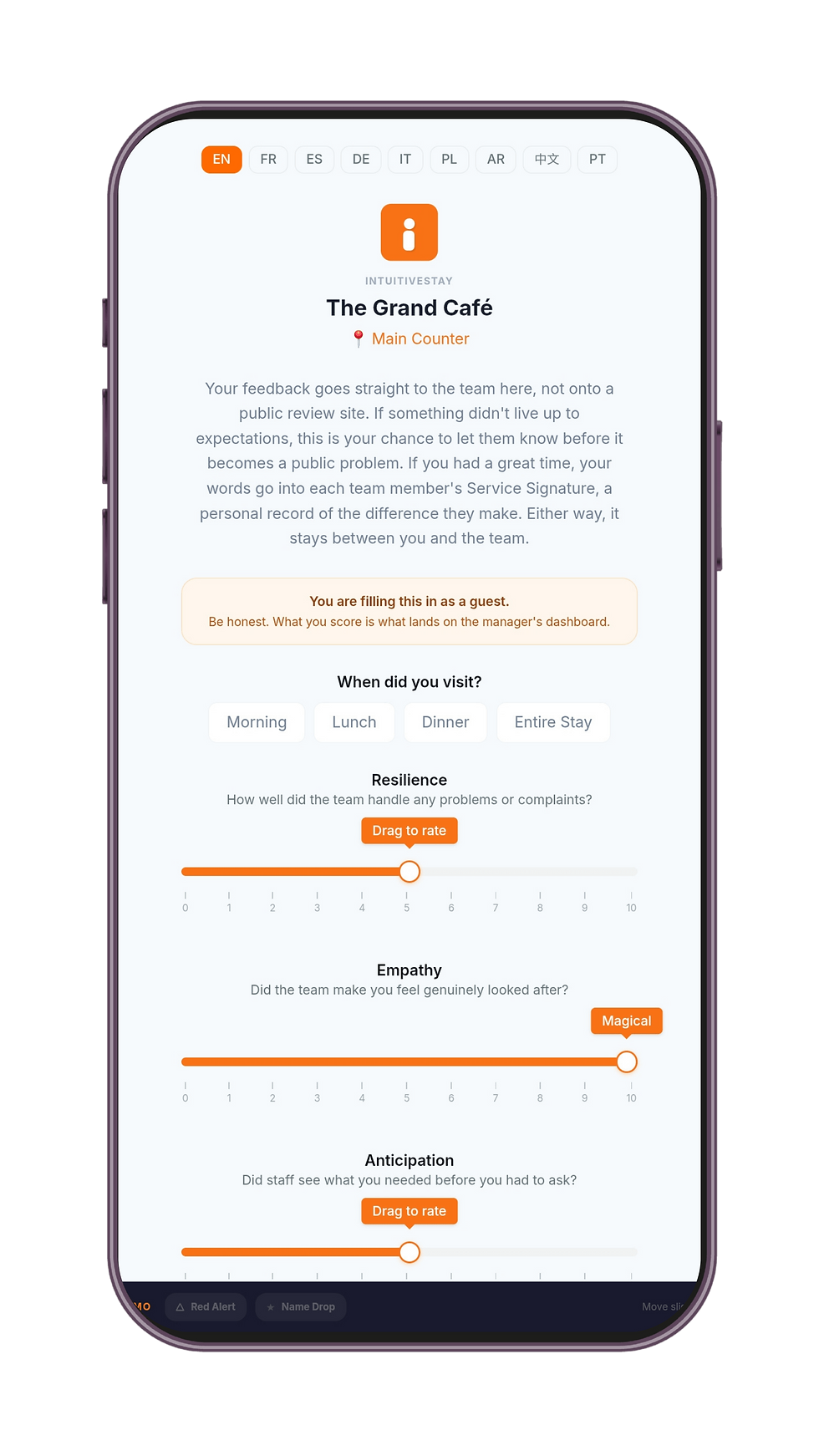
More data points. Defined descriptors at every level. Specific dimensions rather than a single vague number. A mechanism that captures what went wrong in real time rather than weeks later when there is nothing you can do about it.
A scale of ten rather than five because meaningful distance between each point allows you to track genuine movement. An improvement from 6.2 to 7.4 tells you something real happened. An improvement from 3.8 to 4.1 on a five star scale tells you almost nothing.
Descriptors that eliminate the interpretation problem entirely. When every guest understands exactly what they are choosing at every point on the scale, the data becomes genuinely comparable. You can benchmark against your own performance over time. You can benchmark across your team. You can see patterns that a five star score buries entirely.
The hospitality industry has been held hostage by a rating system designed for a different era. One that was never built for the complexity of human experience, the inequality between independent and corporate operators, or the data driven decisions that modern businesses need to make.
Independent hospitality operators deserve better than a number between one and five with no agreed meaning.
That is the change worth building toward and that is why after 20 years of explaining myself every time we got a single low scoring guest review, I finally created the solution we have all desperately been needing, not only that, but improved it and now the next time I use the Guest Connection Score in a hospitality business and the guest review form through IntuitiveStay, if a low score does drop in, I will not need to guess how the guest was feeling or why they scored us a 5, because the form will tell us exactly why.
The best part about low scores now? It does it privately, not online for the world to see.
Benjamin Smith is the Founder of IntuitiveStay™ and creator of the Guest Connection Score™, with 20+ years in global hospitality management.
Visit www.intuitivestay.com to learn more and https://www.intuitivestay.com/guest-connection-score to learn more about what the Guest Connection Score is and how it can help your business.
Frequently Asked Questions About Hotel Guest Review Systems
Why is the 5-star hotel review system inaccurate?
The 5-star system has no agreed definitions for each rating point, meaning a 3-star review from one guest can mean something completely different to another. There is no context, no proportion, and no mechanism to distinguish between a genuinely poor experience and a guest who never awards five stars on principle. The result is that the same number tells you almost nothing consistent about the actual guest experience.
What does a 4.5 star hotel rating actually mean for independent operators?
A 4.5 hotel review score has become the de facto threshold below which many consumers simply will not consider a property. This is devastating for independent operators, because even a single unfair review can push a score from 4.6 to 4.3 overnight, making you effectively invisible to a significant portion of your potential guests. Corporate hotels are protected by brand trust; independent operators are not.
Is there a better alternative to the 5-star hotel review system?
Yes. A defined 10-point scale with word descriptors at each level eliminates the interpretation problem entirely. When every guest sees a word that defines exactly what their number means, the data becomes consistent and genuinely comparable. The Guest Connection Score, developed by IntuitiveStay, uses precisely this approach, capturing guest feedback privately with defined descriptors so operators can act on meaningful data rather than ambiguous star counts.
How can independent hotels improve their guest review scores?
The most effective strategy is to capture guest feedback in real time during their stay, rather than waiting for a post-departure OTA review. When guests can flag issues privately before they leave, you have the opportunity to resolve them and turn a potential low score into a positive experience. Tools like the Guest Connection Score are designed specifically for this purpose, allowing independent hospitality operators to gather structured, private feedback and protect their public rating.

Comments