How Hospitality Staff Retention Starts With Guest Feedback

Updated: Jun 12
Table Of Contents
Here is a number that should stop any hospitality manager in their tracks: 52%. That is the annual staff attrition rate across the UK hospitality industry. More than half your team, gone within a year. Replaced at a cost that the British Hospitality Association estimates at between £3,000 and £5,000 per head when you factor in recruitment, onboarding, and the dip in service quality while a new person finds their feet.
And that figure does not capture the part that keeps operators up at night, losing the ones who were actually brilliant at it. The bartender who remembered regulars' orders. The front-desk host who defused a difficult check-in before it became a bad review. The server who made a family feel genuinely welcome, not just processed. Those people do not grow on trees, and when they leave, often because they felt invisible, unrecognised, or simply had no reason to stay, the gap they leave is felt by guests long before it shows up in your numbers.
The UK hospitality sector currently carries around 132,000 unfilled vacancies, compounding a skills shortage that was already severe before the pandemic reshaped the workforce. Hospitality skills shortage in the UK is not a new conversation, but the urgency has sharpened considerably. The question operators are now asking is not just "how do we hire?" but "how do we hold onto the people worth keeping?" How to retain hospitality staff has become one of the most practically important challenges in the sector, and the answer, for most businesses, remains frustratingly vague.
The Real Cost of Hospitality Staff Retention Failure
Walk into the average hotel, restaurant, or pub and ask how staff performance is measured. You will likely hear about appraisals. Maybe a "team member of the month" board. Occasionally, a manager who prints out a particularly kind TripAdvisor comment and pins it in the break room.
None of this is bad. All of it falls short.
The problem with most employee performance review systems in hospitality is that they are subjective, inconsistent, and invisible beyond the building they happen in. A glowing appraisal from a general manager in Leeds means nothing to a hotel group interviewing that same person in Bristol two years later. A commendation for handling a difficult situation brilliantly disappears when that manager leaves, or when the staff member moves on.
Recognition in hospitality has always been manager-led, which means it is also, inevitably, manager-filtered. Whether consciously or not, the people who get noticed tend to be the people their manager notices. That might mean the most visible shifts. The most confident personalities. The team members who are best at managing upward, rather than those who are quietly brilliant at managing the guest in front of them.
Employee recognition in hospitality, at its worst, becomes a popularity contest with no paper trail and for staff, particularly those earlier in their careers, there is no accumulating record of their work. Nothing portable. Nothing verified. Nothing they can point to and say: this is what I've built.
For an industry already battling hospitality staff retention at every level, that is a significant structural problem. People stay where they feel seen and valued. When the mechanism for being seen is inconsistent, opaque, or tied entirely to one manager's opinion, the most capable staff often quietly start looking elsewhere.
What If the Guest Feedback You Already Collect Could Do More?
Most hospitality businesses are already collecting guest feedback. Post-stay surveys. Google reviews. Feedback forms after a meal. The data exists. The question is what happens to it.
In the vast majority of cases, it gets aggregated into property-level scores. An average rating. A trend line. Occasionally a flag if something has gone badly wrong, but the individual, the team member who created that experience, whose warmth or attentiveness or quick thinking is the reason a guest gave five stars, rarely sees any of it and they certainly do not own it.
"The guest already knows who made their stay special. The problem is that nobody's been capturing that information in a way that's useful to the person who earned it."
Using guest reviews to recognise staff is not a new idea in principle, managers have always been able to share kind words, but systematising it, making it objective, making it portable, and making it something the staff member themselves can carry forward in their career, that is something the industry has not had. Until now.
Introducing the Service Signature

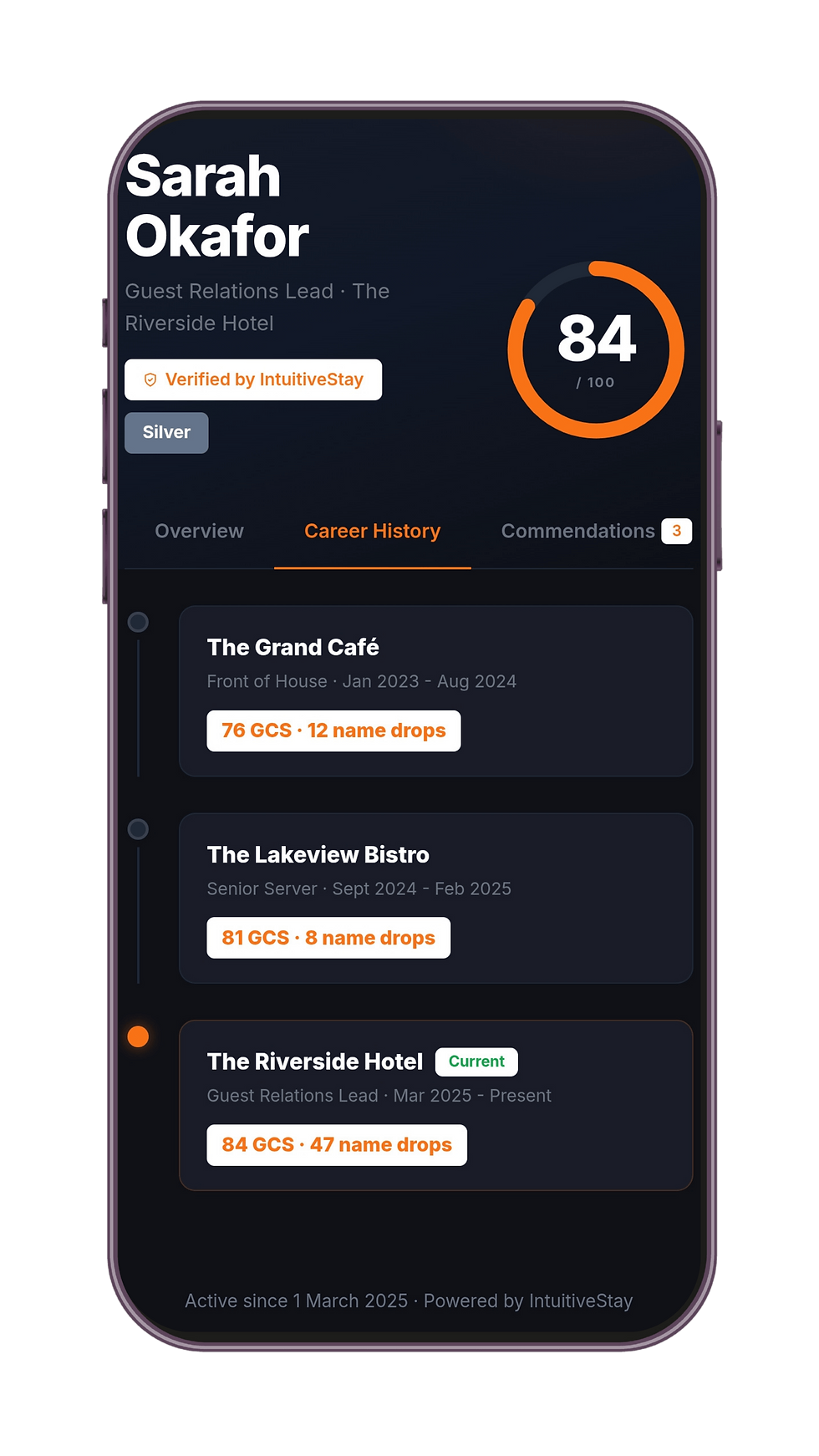
The Service Signature is a feature built into IntuitiveStay's feedback platform. It is, at its core, a portable, verified career profile for hospitality staff built automatically from real guest feedback scores accumulated over time.
When a guest completes an IntuitiveStay feedback session and names a staff member, rating that interaction positively, that data feeds directly into the named individual's Service Signature. No manager mediation. No subjective filter. The guest spoke; the record was made.
The profile is built on the Guest Connection Score (GCS™), IntuitiveStay's proprietary metric for measuring the quality of the emotional connection between a hospitality professional and the people they serve. The GCS draws on four pillars, captured under what IntuitiveStay calls the REAR framework:
Resilience - How a team member handles difficulty, pressure, and the moments when things go wrong.
Empathy - Whether guests feel genuinely understood, not just processed.
Anticipation - The capacity to read a situation and meet a need before it is voiced.
Recognition - Making guests feel seen as individuals, not as room numbers or table covers.
These four dimensions map to the qualities that distinguish truly outstanding hospitality professionals from competent ones. They are also qualities that are notoriously hard to capture with conventional appraisal processes, because they live in small moments, a tone of voice, a well-timed gesture, a problem solved quietly before it became visible.
The Service Signature aggregates those moments into a verified hospitality staff profile that grows over time and travels with the individual wherever their career takes them. If they move from a B&B in Cornwall to a city-centre hotel in Manchester, their Signature comes with them. Their record of real guest feedback for staff does not disappear because an employer changed.
What It Means for Staff: Something to Own, Build, and Take With Them
For hospitality professionals, particularly those who have spent years feeling that their work is invisible once they clock off, the Service Signature offers something genuinely different: a portable career record in hospitality that is grounded in evidence.
Hospitality career progression has always been complicated by the fact that the industry runs on experience that is hard to quantify. You cannot easily show a future employer that you are brilliant at turning around a difficult moment with a guest. You can tell them, but telling is not the same as showing. A verified record of positive guest interactions, built up over months or years, changes that equation.
"Most hospitality staff have never had a way to show what they're actually good at. The Service Signature gives them a record that no single manager can take away."
For a junior team member just starting out, this matters enormously. How to show career achievement in hospitality has previously meant hoping someone senior writes you a reference. Now it means building a real-time, guest-verified record of your own capabilities across the REAR framework.
For more experienced professionals, head of housekeeping, senior front-of-house, experienced managers, the Service Signature becomes a portfolio. A document of sustained excellence that speaks for itself in job applications and interviews. It is the hospitality equivalent of a performance record, except it is built by the people whose opinion actually matters: the guests.
There is also something worth saying about what this does for motivation in the short term. Knowing that a positive guest interaction is being captured and credited to you personally changes the way the work feels. It is not invisible anymore. It counts, not just as a number on a property-level dashboard, but as your number, on your profile, building your record.
What It Means for Operators: Retention, Motivation, and Reduced Bias
From an operator's perspective, the Service Signature solves several problems at once.
On hospitality staff retention: the most consistent finding in staff satisfaction research is that people stay where they feel valued. Hotel staff incentive programmes that are purely financial, bonuses, tips, pay reviews, are effective up to a point, but they do not address the deeper need to feel that good work is seen and acknowledged. The Service Signature creates a visible, ongoing acknowledgement mechanism that requires no extra effort from managers and is driven by the guests themselves.
How to motivate hotel staff is a question with many answers, but one that is consistently underused is: show them that their work is building something for them personally. A team member who can see their GCS score growing, who can watch their Signature develop over a season, is a team member who has a reason to invest in the work that goes beyond their next pay cheque.
On positive guest reviews and staff impact: properties that are able to link guest feedback directly to individual team members gain something operationally valuable, an honest view of where the guest experience is being made and where it is being lost. That information can shape scheduling, training priorities, and mentoring in ways that broad property-level scores simply cannot.
On the skills shortage: operators who offer the Service Signature to their team have something genuinely distinctive to put in front of candidates. In a market where hospitality staff retention is a critical competitive issue, being able to say "your work here will build your verified career profile" is a meaningful differentiator. It speaks to candidates who are thinking about their long-term career, not just their next shift.
Moving Beyond Bias in Hospitality Recognition
There is a harder conversation to have here, and it is worth having directly.
Bias in workplace recognition is not unique to hospitality, but it is particularly acute in an industry where so much depends on informal relationships, visible personalities, and the goodwill of individual managers. Hospitality staff recognition without bias is not something most current systems are designed to deliver, not because operators are bad people, but because the mechanisms they have available are inherently subjective.
When recognition flows primarily from manager observation, unconscious preferences shape the outcomes. Who gets the commendation. Whose name goes on the team member of the month board. Whose excellent work gets mentioned at the next staff meeting. Research consistently shows that these decisions, made with no ill intent, tend to favour certain personality types, certain communication styles, and certain levels of social confidence, none of which correlate reliably with actual guest experience quality.
Guest-verified data is different. Guests do not know the internal politics of your team. They do not know who is well-liked in the break room or who is best at managing up. They know what their experience felt like and who contributed to it. When that data is captured systematically and fed into individual profiles, the result is a recognition system that is meaningfully more equitable and meaningfully more credible than anything built on manager discretion alone.
For staff who have historically been overlooked despite doing excellent work, this is not a small thing. For operators who are serious about building a genuinely inclusive workplace culture, the Service Signature gives them a structural mechanism to back that commitment up.
Recognition That Works for Everyone
The hospitality industry is full of people who are extraordinarily good at what they do and who have almost nothing to show for it. No portable record. No verified proof of their capabilities. No way to communicate to the next employer, or the one after that, what they have built over years of guest-facing work.
Meanwhile, operators are spending thousands replacing people they could have kept, if only there had been a better mechanism for showing those people that their contribution was seen, valued, and recorded.
The Service Signature is not about adding complexity to your operation. It works alongside the guest feedback you are already collecting and turns it into something that benefits your team directly. The guest does the heavy lifting. The data does the rest.
For staff, it is a career asset that grows with every shift. For operators, it is a retention and motivation tool that runs in the background, quietly making the case to every team member that their work here matters, not just to the property, but to their own future.
That is what employee recognition in hospitality should look like: objective, portable, and built by the only people whose opinion cannot be questioned, the guests themselves.
Benjamin Smith is the Founder of IntuitiveStay™ and the creator of the Guest Connection Score™ , the world's first trademarked emotional intelligence metric in hospitality. IntuitiveStay™ is a guest intelligence platform built exclusively for hospitality businesses.

Comments