The Real Cost of Hospitality Staff Turnover (And Why Your Reviews Are Paying the Price)

Updated: Jun 12
Table Of Contents
Let me give you a number that the industry rarely says out loud.
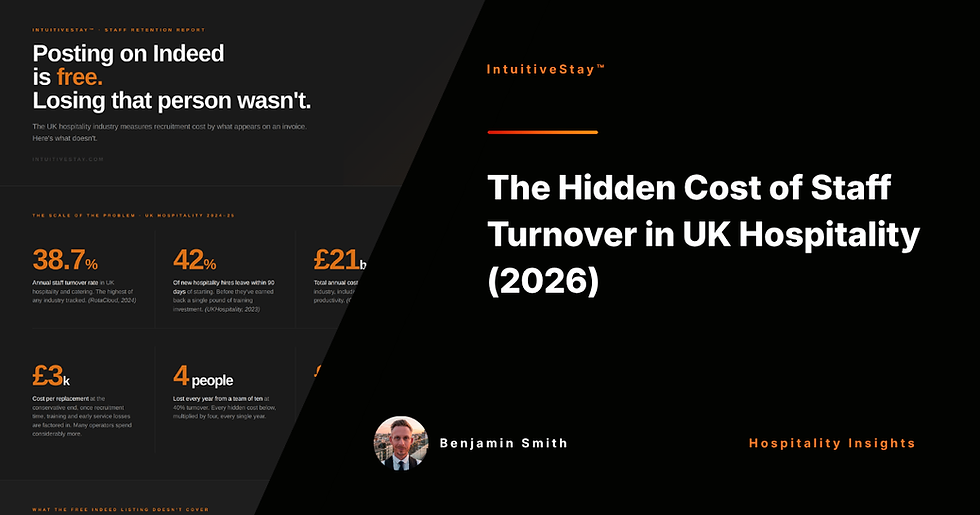
The average cost of replacing a single hospitality employee in the UK is estimated at between £4,000 and £6,000 when you factor in recruitment, onboarding, training, and the productivity gap while the new hire finds their feet. In a high-turnover kitchen or front-of-house team, that number does not happen once.
It happens repeatedly, quietly, and almost always without anyone joining the dots between the departures and the decline in what guests are experiencing on the other side of the pass.
The hospitality industry has a staff turnover problem. But the reason most owners cannot solve it is that they are looking at it the wrong way.

UK Hospitality Staff Turnover, And What It Actually Means
UK hospitality staff turnover currently sits at around 30 percent annually, almost three times the national average across all industries. In some sectors, particularly food service and hotel housekeeping, the figure is closer to 45 percent. These numbers get cited in trade publications, nodded at in industry events, and then largely accepted as the cost of doing business in a people-heavy sector.
They should not be accepted. They are a symptom of something fixable.
When a member of your front-of-house team leaves, what leaves with them is not just a body filling a rota slot. It is the accumulated knowledge of your returning guests. It is the intuition about which table needs checking on and which guest prefers to be left alone. It is the confidence a regular feels when they walk through the door and are greeted by someone who actually knows their name.
That is not replaceable in a week. It is barely replaceable in a month. And while the gap exists, your guests feel it, whether they can name what is missing or not.
The Emotional Intelligence Drain Staff Turnover Creates (And Nobody Measures)
Here is what the industry's standard HR metrics will never tell you: staff turnover does not just cost you money. It costs you emotional intelligence.
The four pillars of a great guest experience, empathy, resilience, recognition, and anticipation, are not skills that arrive fully formed on day one of someone's employment. They are developed through repetition, confidence, and the kind of deep familiarity with your property, your guests, and your standards that only comes with time.
When your anticipation scores are high, it is almost always because your experienced team members have learned to read the room. The waiter who refills the coffee before it is empty. The receptionist who spots that the couple in Room 4 are on their honeymoon and sends a small gift to their room. These are not instincts that survive a 45 percent annual churn rate.
And yet, almost no business in the independent sector is measuring the relationship between staff tenure and guest experience quality. They measure covers served. They measure rooms cleaned. They measure speed. They do not measure whether the warmth that made their regulars loyal is still in the room, until it is already gone and the reviews have started to soften.
Why Your Best Staff Are Leaving (And It Is Probably Not About the Money)
When hospitality businesses conduct exit interviews, those that conduct them at all, the most common responses revolve around feeling undervalued, invisible, and unchallenged.
Not underpaid. Unseen.
A survey by the hospitality careers platform Caterer.com found that 67 percent of hospitality workers who left their role in the previous 12 months cited "lack of recognition" as a contributing factor. More than two thirds. In an industry built on the art of making other people feel recognised, the people delivering that art are walking out the door because nobody is doing it for them.
This is not a complex problem. It is an ignored one.
The independent sector, in particular, tends to run on goodwill, pressure, and the assumption that a passionate team will stay passionate indefinitely without any formal acknowledgement of how they are actually performing. When things go wrong, it tends to be addressed. When things go brilliantly right, it is taken for granted.
Great hospitality staff do not just want a thank you. They want evidence that what they bring to the floor matters. They want to know that their empathy score went up this week. They want to know that their handling of a difficult situation on Saturday night was noticed by the person who signs their payslip, not six months later at an annual appraisal, but on Sunday morning.
What Hospitality Staff Retention Actually Looks Like in Practice
The businesses with the lowest staff turnover in the independent sector are not always the ones paying the most. They are the ones where the team feels like a team, where performance is visible, development is personal, and there is a clear line between the effort an individual puts in and the recognition they receive for it.
This is not a culture that happens by accident. It is built with intention, and increasingly, with data.
When your team can see their own Guest Connection Score evolving in real time, when they know that their resilience score climbed this week because they handled a complaint with grace, something shifts. The work stops being abstract. The standard stops being invisible. And the ownership they feel over their own performance becomes a reason to stay, to grow, and to take genuine pride in what they do.
The properties that are going to win the retention battle in the next five years will not be the ones with the best perks packages. They will be the ones who gave their staff something the corporate chains rarely offer: the feeling of being genuinely, measurably excellent at something that matters.
The Guest Experience Cost of Staff Turnover You Are Not Calculating
If you take one thing from this, make it this.
Every time a member of your experienced team leaves, your guest experience quality drops for a period you cannot precisely measure, by an amount you are probably not tracking, at a cost that never appears in a single line on your P&L.
The guests who notice the change are unlikely to tell you. They will simply book somewhere else next time, or leave a review that says "it wasn't quite what we remembered," without ever explaining that what changed was not the room or the menu, it was the human warmth that used to fill the space between those things.
Staff turnover and guest experience quality are not separate problems. They are the same problem, viewed from different ends of the same conversation.
Until you are measuring both, with the same rigour, in real time, and with the same urgency you apply to your food costs, you are managing one half of your business with your eyes open and the other half in the dark.
The independent sector cannot afford that anymore. The margins are too thin, the guests too discerning, and the gap between a good year and a great one too dependent on the people who show up every day and choose to give a damn.
Give them a reason to keep choosing it and join IntuitiveStay™ and more importantly, get your Guest Connection Score
Benjamin Smith is the Founder of IntuitiveStay™ and the creator of the Guest Connection Score™ - the world's first trademarked emotional intelligence metric in hospitality. IntuitiveStay™ is a guest intelligence platform built exclusively for independent hospitality businesses.
Frequently Asked Questions
What is the real cost of staff turnover in UK hospitality?
Replacing a single hospitality employee in the UK is estimated to cost between £4,000 and £6,000 when you account for recruitment, onboarding, training and the productivity gap while the new hire settles in.
In high-turnover businesses, this cost compounds rapidly. Beyond the direct financial hit, there is also the harder-to-measure cost of declining guest experience quality during transition periods, which directly impacts reviews, repeat bookings and revenue.
Why do hospitality staff really leave their jobs?
Contrary to popular assumption, pay is rarely the primary driver of departure. Research consistently shows that people leave managers, not jobs.
In hospitality, the most common reasons staff leave are a lack of recognition, feeling undervalued, poor management communication and the emotional exhaustion of giving excellent service while receiving little in return.
Businesses that prioritise staff wellbeing, recognition and genuine leadership retain their people at significantly higher rates than those that focus only on wages.
How does staff turnover affect guest reviews?
Directly and significantly. When experienced staff leave, they take with them the institutional knowledge, established guest relationships and emotional intelligence that made the experience memorable.
New team members, however talented, need time to reach the same level of fluency with guests. During that transition, subtle but noticeable drops in service quality occur. Guests who had come to expect a certain warmth or attentiveness often notice the difference, even if they cannot articulate exactly what changed, and that dissatisfaction frequently finds its way into reviews.
What does good staff retention look like in practice?
Genuine retention is built on three pillars: meaningful recognition, clear development pathways and strong day-to-day leadership.
Practically speaking, this means managers who check in with their teams regularly and sincerely, a culture where excellent work is noticed and acknowledged specifically, and an environment where people can see a future for themselves. It also means measuring how staff feel, not just how guests feel, because the two are far more connected than most operators realise.
What is the emotional intelligence drain in hospitality?
When experienced staff leave a hospitality business, they take more than their skills, they take their emotional intelligence. The ability to read a regular guest's mood, to know which table needs a quieter service style, to sense when a family is having a difficult trip and respond with extra care: these capabilities take months or years to develop.
They cannot be recruited for or trained in a week. Each departure represents a quiet erosion of the emotional depth of your guest experience, and it is a cost that almost no business is currently measuring.
Comments