When Did Hospitality Staff Stop Being Considered the Most Important Part of the Business?

Table Of Contents
The Staffing Crisis Is Not Bad Luck, It Is the Bill Arriving.
Harvard Proved This Was Commercially Stupid in 1994. The Industry Ignored It.
When a Hospitality Job Advertisement Is Not a Benefits Package. It Is a Performance.
The Neuroscience of Recognition That the Industry Has Never Bothered to Apply
Hospitality Staff Have No Portable Professional Identity. That Is a Problem We Created.
The Guest Experience Is Not a Product. It Is a Feeling. And Feelings Come From People.
What Good Hospitality Business Owners Actually Do Differently
The Industry Is at a Crossroads. Most Businesses Have Not Noticed Yet.
Why Do Hospitality Staff Leave Their Jobs?
Research shows the primary reason hospitality staff leave is not pay but a lack of recognition. The UK hospitality sector has a 52% staff turnover rate according to CIPD, with 42% of new starters leaving within 30 days. The Hospitality People Survey 2026 found that pay satisfaction has increased while happiness has fallen, indicating that staff leave because they feel unseen, not underpaid.
I started in hospitality as a pot wash, not a gap year, not a stepping stone on a planned career trajectory. Just a teenager in a hot kitchen being told to keep up. From there I worked my way through every level of this industry across the UK, Hong Kong, Thailand, New Zealand and Australia over twenty years of service, management, and eventually boardrooms. I broke records in some of those roles. I exceeded every measurable target put in front of me and in one of them, near the top of my career, I was let go for professionally raising concerns about how people in that business were being treated, that last sentence is not a grievance it is purely a fact.
What happened to me is not unusual in this industry, it is the industry. The people who care enough to speak up about how staff are treated tend to find themselves on the wrong side of the organisations that most need to hear it, the culture eats the feedback, the targets get hit and the people who hit them leave and the business calls it a staffing problem.
The best operations I ever worked in had one thing in common, the staff felt like they mattered and the worst ones had something in common too, they didn't.
That observation should not be controversial but somewhere between the first hotel ever built on human warmth and the industry we have today, hospitality made a quiet, catastrophic decision. It decided staff were a cost to manage rather than an asset to invest in and it has been paying for that decision ever since, mostly in ways it refuses to connect to the original choice.
The Staffing Crisis Is Not Bad Luck, It Is the Bill Arriving.
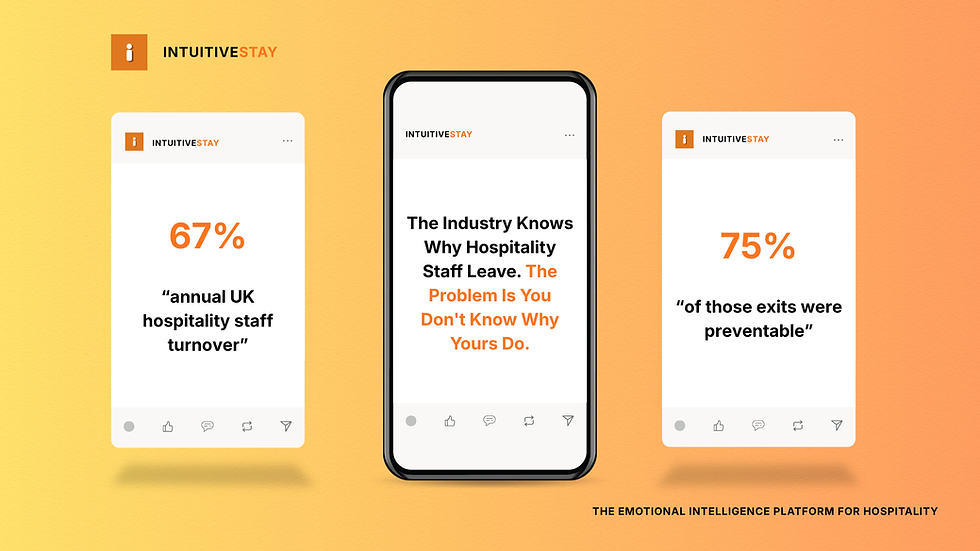
According to CIPD, hospitality sits at 52% staff turnover against a UK average of 34%. RotaCloud's 2024 data covering over 4,000 accounts found bars and clubs hitting 47%, quick-service restaurants 43% and restaurants and cafés 39%. UKHospitality reports that 42% of staff leave within the first 90 days of employment. A YouGov survey found 42% leave within their first 30 days.
Read that again, nearly half your new starters are gone before they have completed a single month.
The industry has named this a crisis, it has lobbied government about it, written reports about it and held conferences about it. What it has rarely done is look honestly at the cause because the cause is not a labour market problem, It is not Brexit, although Brexit accelerated it. It is not the cost-of-living crisis, although that made it worse. It is thirty years of an industry communicating, through its actions, that the people who do the work are the least important part of the business.
Harvard Proved This Was Commercially Stupid in 1994. The Industry Ignored It.
In 1994, three professors at Harvard Business School published a paper in the Harvard Business Review that should have changed how every service business thinks about its people. James Heskett, W. Earl Sasser and Leonard Schlesinger laid out what they called the 'service profit chain', a quantifiable, evidence-based framework demonstrating that employee satisfaction directly drives customer loyalty and customer loyalty directly drives profitability. Not loosely correlates but directly drives.
Their subsequent book, published in 1997 after five years of research across companies including Ritz-Carlton, British Airways and Southwest Airlines, showed that organisations which invested in staff welfare, recognition, and development consistently outperformed those that did not.
The chain was simple, satisfied employees produce better service, better service produces loyal customers, loyal customers produce sustainable profit.
Thirty years later, the hospitality industry is still running in the opposite direction. Turnover is treated as industry standard, recognition is an afterthought, career development is an aspiration with no infrastructure to support it and the companies benchmarked in Heskett's research continue to dominate their sectors while the rest argue about minimum wage increases.
The research was not ignored because it was wrong, it was ignored because acting on it was harder than accepting churn as a fixed cost of doing business.
When a Hospitality Job Advertisement Is Not a Benefits Package. It Is a Performance.
Open any hospitality job listing in the UK right now and read the benefits section. You will find some version of the same list on virtually every post: staff meals on shift, 30 or 50 percent employee discount, free car parking, access to a discount platform and somewhere near the bottom, something that sounds progressive and modern, access to Wagestream or a similar earned wage access service.

That list has become so standardised that operators copy it almost without thinking and in doing so they have done something quietly revealing, they have shown exactly what they think their staff are worth.
A meal they would have to provide anyway, a discount off the product the employee just spent eight hours making or serving, a parking space and a financial tool that, for a significant number of the young, financially stretched workers most likely to use it, functions less like a benefit and more like a trap.
The Wagestream point deserves to be said plainly because nobody in the industry is saying it.
The product is marketed to employers as a financial wellbeing tool. The theory is reasonable, instead of waiting for a monthly pay cycle, staff can access wages they have already earned and this in turn reduces financial stress, the argument goes, and financially settled employees perform better. There is research to support that in principle.
What that research does not capture is what happens to the users who pull their wages early, not because of a genuine emergency but because they are young, underpaid and operating without a financial safety net, which describes a very large proportion of frontline hospitality workers in the UK and likely worldwide. A Pizza Express worker who spoke to The Guardian described the pattern directly, "It is easy to fall into a negative pattern, streaming wages early but imagine streaming wages and also loan payments. You could end up being a wage slave, having to work just to pay your debts back."
The psychological mechanism here is specific and it matters. A worker pulls money early because they need it. A fortnight later, their pay cheque arrives and it is smaller than expected. The rational explanation is straightforward, they accessed that money earlier but financially stressed people, particularly younger ones operating month to month with no savings buffer, do not always experience it that way. What they feel is that they worked a full month and got paid less than they expected. The cause and the consequence are separated by two weeks and by the cognitive distance of a transaction they may not fully remember or register the fact they have already had what they are entitled to.
A survey by Bankrate found that 50% of Millennials and 47% of Generation Z say money negatively impacts their mental health. These are the people most likely to use earned wage access services, they are also the people least equipped to manage the psychological gap of early access followed by a reduced pay cheque, because the reduced pay cheque does not feel like the consequence of a decision they made. It feels like evidence that the job is not worth it.
The same logic applies, with varying degrees of severity to the rest of the standard hospitality benefits package. A staff meal during a shift is not a benefit, it is a basic operational necessity in an environment where people are on their feet for eight hours surrounded by food they cannot eat without it being provided. Calling it a perk is the employer's way of listing something they were already obligated to provide as though it represents generosity.
Of course, there is an argument here, staff are given unpaid breaks and could quite easily make, or purchase their own food, but this is my entire point entirely, your staff could do that, but this is the whole point of this article and touches on something I said in the opening of this post....'That observation should not be controversial but somewhere between the first hotel ever built on human warmth and the industry we have today, hospitality made a quiet, catastrophic decision. It decided staff were a cost to manage rather than an asset to invest in'.
A 35% employee discount is similarly revealing. It signals that the employer believes staff will want to spend their limited income at the venue where they work, on their days off, in the building they spent their working week trying to improve. For some staff that might be genuinely appealing, for most, it is a discount they will rarely use, listed on a job ad to make a thin package look fuller.
None of this is to say these things have no value at all. Staff meals matter, earned wage access, used responsibly and with proper financial education by someone who genuinely understands how it works, can reduce short-term financial stress. The problem is not the individual components, the problem is what the list communicates as a whole.
It communicates that the employer has thought about what costs the least to offer rather than what the employee actually needs. It communicates that the HR team had a template and filled it in, it communicates, most importantly, that the organisation has confused the performance of caring with caring itself.
You cannot build a team that feels valued on a staff meal and a parking space. You cannot retain people who are psychologically convinced they worked a full month for half their expected pay cheque and you cannot claim to care about your people's financial wellbeing while listing a product that left one worker describing herself, in her own words, as a wage slave.
The industry knows how to write a benefits package that looks right but what it has not yet learned is how to build one that actually is.
What Hospitality Staff Turnover Actually Costs You
Replacing a member of staff costs between six and nine months of their salary, according to Oxford Economics. For a hospitality role paying £25,000 a year, that is between £12,500 and £18,750 per departure. The cost breaks into two components: the logistical cost of recruiting, which Oxford Economics puts at an average of £5,433, and the cost of lost output while a replacement reaches the productivity level of the person they replaced, which takes an average of 12 weeks.
For the lowest-paid roles, the percentage is lower but the volume is brutal. If you run a restaurant with 20 staff and a 42% first-month turnover rate, you are replacing eight or nine people within 30 days of hiring them every single time.
The April 2025 National Insurance changes added at least £2,500 to the annual cost of employing each full-time member of staff, according to UKHospitality chief executive Kate Nicholls. Her words on the impact were direct: venues would have to "cut hours, scale back recruitment and, in extreme circumstances, let people go." The industry responded by cutting, as it always does, starting with the investments in people that would have reduced the very turnover making the finances unsustainable. It is a destructive loop.
The Ritz-Carlton Understood What Most Operators Still Don't
Every employee at the Ritz-Carlton, from the housekeeper to the front desk agent, is authorised to spend up to $2,000 per guest, per incident, to resolve a problem or create a memorable experience. No manager approval, no form to complete, just trust, extended to every person in the building.
The coverage this policy receives tends to focus on the customer service angle. What most of that coverage leaves out is the number that made the policy possible in the first place. The average lifetime value of a Ritz-Carlton guest is £220,000. When you know that, £2,000 is not a risk. It is a rational investment in a relationship worth two hundred and fifty times more.
The policy is not only financially rational, It also communicates something to the people carrying it out. It says: we trust your judgement, we believe you are capable of making the right decision, your role in this building is not to wait for permission, It is to take care of the guest.
That communication, repeated every day through culture and policy and trust, is why Ritz-Carlton staff stay. It is why the brand's service is consistent across hundreds of properties in dozens of countries. It is not the £2,000, It is the signal the £2,000 sends about how much the organisation values the people spending it.
Most hospitality businesses send the opposite signal and then wonder why their staff leave. The answer here is not copying the Ritz, but there is a point there. Whether you give your team the ability to give out X amount of coffees if you run a cafe, X amount of bottles of wine if you are a restaurant and or a free upgrade when your occupancy allows if you are run a hotel.
The Neuroscience of Recognition That the Industry Has Never Bothered to Apply
Recognition activates the brain's dopamine reward pathway, this is not motivational poster science. It is neuroscience. Am I going to pretend that I have a full understanding of neuroscience, absolutely not, but whilst researching for this post, I learned. I asked the right questions, I delved deep, I was shown answers I never even asked for whilst exploring related topics or research so I could write this post.
One thing I am sure of however, is that everyone knows what dopamine is. Dopamine reinforces behaviour, increases motivation and strengthens the neural pathways associated with the action that triggered the reward. When a staff member receives specific, genuine recognition for doing something well, their brain encodes that behaviour as worth repeating. If you have a dog then you already know this.
The reverse is equally true, absence of recognition deteriorates what researchers call positive psychological functioning, the internal conditions that allow a person to feel competent, purposeful and connected to their work, when those conditions degrade, performance degrades with them.
The ADP Research Institute found that worker motivation hit its lowest recorded point in August 2023. The Hospitality People Survey published in 2026 found that happiness among UK hospitality staff had fallen from 69% in 2024 to 54% in 2026. Thirty-six percent said work now has a negative impact on their mental health. Only 52% of hospitality employees said they were likely to stay in their current role, down from 62% in 2024.
These are not figures about pay, pay satisfaction has actually increased, from 51% in 2025 to 63% in 2026 which I talked about in my previous article https://www.intuitivestay.com/post/reduce-staff-turnover-hospitality. People are not leaving because they are underpaid, they are leaving because they are not seen and as a result, the industry has been having the wrong conversation.
Hospitality Staff Have No Portable Professional Identity. That Is a Problem We Created.
A nurse has a professional register, a tradesperson has certifications and an accountant has chartered status. Their professional identity exists independently of whoever currently employs them. They carry it with them, it grows over time and it is recognised by the wider world as having genuine value.
A front of house manager with fifteen years of experience handling difficult guests, managing service under pressure, developing junior staff and building relationships with regulars has nothing equivalent. A CV with job titles and dates and that is it.
The industry created this gap and then acted surprised when people do not treat hospitality as a long-term career. Why would you invest in developing expertise in a sector that has no mechanism for recording or recognising that expertise? Why would you push yourself to be excellent in a role where excellence leaves no trace?
I have personally heard from previous employees and in interviews that I have conducted with candidates that they were top performers in their last role, mentioned all over Tripadvisor and Google but were fired because the manager did not like them or because they refused to 'kiss ass'. As such, the one thing hospitality staff have to rely on, which is generally a reference letter or support, is gone, just because the manager made it personal.
The 2026 Hospitality People Survey found that growth and stimulating work now outweigh pay as the primary motivators for staff retention. People want development, they want to feel like the work they do is building towards something, the industry is not giving them that. It is giving them a wage, a rota and a goodbye and then it calls the resulting vacancy a staffing crisis.
I do not want to be that guy that just talks about the problems that we all seem to know but choose to either continuously talk about whilst doing absolutely nothing about it, that is why I created the Service Signature. A tool for hospitality staff who can now have something tangible to showcase how they made all their previous guests feel as well as an achievement wall to give them motivation to push for more positive reviews which in turn, also benefits your business by means of increased positive reviews, renewed staff and likely increase average spend.

The Guest Experience Is Not a Product. It Is a Feeling. And Feelings Come From People.
Sixty-five percent of consumers say personalisation will earn their loyalty. Sixty-three percent will stop spending with a brand that uses poor personalisation strategies, according to research published by Torrens University. In hospitality, personalisation is not an algorithm, it is the server who remembers a regular's usual order, the front desk agent who notices a guest looks stressed and upgrades them without being asked, essentially the small things that make a guest feel like a person rather than a booking reference.
These moments cannot be automated, templated, or replicated by technology, they require a person who is present, engaged and emotionally invested in the guest in front of them.
A person who is on their third week at the job because the previous person left is not that, the same way a person who has been on a split shift for the fourth time this week because the team is understaffed is not that and also the person who has received no feedback for three months except when something went wrong is not that.
The 2024 Axonify survey of UK hospitality managers found that 41% had observed a direct decline in service quality as a result of staff shortages and the pressure placed on remaining teams with half noting longer wait times, these are the visible symptoms. The root cause sits much further back, in the years of treating staff as interchangeable and replaceable rather than as the single most valuable asset in the building.
The guest experience degrades not because the product is bad, it degrades because the person delivering it has stopped caring and they stopped caring because the business stopped showing that it cared about them first. Of course, it is only fair to say that this is not always the case and this can also be reversed.
What Good Hospitality Business Owners Actually Do Differently
The businesses with low turnover, consistent guest scores and staff who stay are not running revolutionary HR programmes, they are doing things that should be standard but have become exceptional by contrast.
They tell their team specifically what they did well, with evidence, not "good job tonight" but "the table in the corner came in unhappy and left asking to make a booking and that was because of how you handled it." They track how guests respond to individual staff members and share that information with the people who earned it. They treat retention as a commercial calculation rather than a people management problem and they give staff a reason to invest in their own performance beyond the next pay cheque.
The ROI is not complicated to calculate if replacing a member of staff costs the equivalent of three to six months of their salary, and a staff member stays six months longer because they feel recognised and valued, you have already covered the cost of whatever you invested in recognition before accounting for the improvement in guest experience, the reduction in training costs, or the institutional knowledge that stayed in the building instead of walking out of it.
The Industry Is at a Crossroads. Most Businesses Have Not Noticed Yet.
There are approximately 176,000 hospitality businesses in the UK, according to the Office for National Statistics. Of those, 97.7% are small businesses. These are not faceless corporations with HR departments and talent management strategies, they are individuals, often running properties they built or inherited, working alongside their teams every single day.
The pressures on them are real and significant as costs are rising, margins are thinner than they have been in a generation, forty-five percent of owners have already reduced their opening hours or capacity because they cannot find or keep staff. A quarter of hospitality businesses have no cash reserves at all, according to UKHospitality's quarterly survey.
In that environment, investing in staff recognition and development can feel like a luxury, that framing is the problem. It is not a luxury, it is the thing that determines whether the business still has a functioning team in six months' time.
I got fired for saying something like that once. I professionally raised poor conduct from the people I was supposed to answer to in a business that was hitting its numbers but hollowing out its people to do it. The numbers kept looking good right up until they didn't, that unfortunately is always how it goes.
The hospitality businesses that come through the next five years will be the ones that figure this out before the reviews, the resignation letters and the closed doors tell them what they got wrong.
The ones that do not will carry on replacing 42% of their staff every thirty days, paying £12,500 a departure, watching their guest scores drift downwards and calling it a crisis. It is not a crisis, It's a choice and it is still a choice.
Look after your people and they will look after your business, I say this from 20 years experience in this industry.
Benjamin Smith is the founder of IntuitiveStay™, a UK-registered guest feedback and staff recognition platform built specifically for independent hospitality businesses. The platform helps operators intercept negative guest feedback before it goes online and gives frontline staff a portable professional credential built from verified guest mentions. It is the first platform of its kind to treat the staff experience and the guest experience as the same problem.


Comments